
[Case study] Nomadic Plants
Research On Stewardship, Transience, and the Art of Letting Go

Can caring for a plant—temporarily, intentionally, and then passing it on—teach us something about how to live a nomadic life more fully? That’s the question I set out to explore during Sanctuary, a three-week sociotechnology residency in Chiang Mai, Thailand.


My hypothesis was simple: stewardship can replace ownership. That in a life defined by movement, what matters isn’t permanence but the quality of attention we bring to each temporary situation. The plant was a test case. The real subject was us.
What I found confirmed the hypothesis - but with an unexpected twist. Caring for something you know you’ll have to give away doesn’t diminish the relationship. It intensifies it. And the patterns that emerged in how people cared for their plants turned out to reveal a great deal about how they relate to everything else in their lives.
This article walks through the research, the findings, and the design questions it opens up. By the end, I hope you’ll see plant care less as a hobby and more as a practice - one that nomadic life might actually be uniquely suited for.
Research Design
Sanctuary brings together digital nomads, technologists, designers, and entrepreneurs to explore emerging technologies, social systems, and embodied experience in Southeast Asia’s remote work hub. I used it as a field site for a three-week observation study.
The project unfolded in three phases:
Phase 1: Selection. I researched plants suited to the Thai climate—easy to maintain, compact, visually diverse—then visited Kham Thiang Garden Market in Chiang Mai and handpicked five plants, each distinctly different in appearance and care requirements.
Phase 2: Plant-Human Bonding Workshop. Rather than random assignment, I facilitated a workshop where participants chose their plant through resonance and recognition. The selection process itself became data: what draws someone to a particular living thing? What do they see in it?


Phase 3: Observation. Over 1.5 weeks, I observed how participants integrated plant care into their routines, documented their reflections, and navigated the handover process as the residency ended.
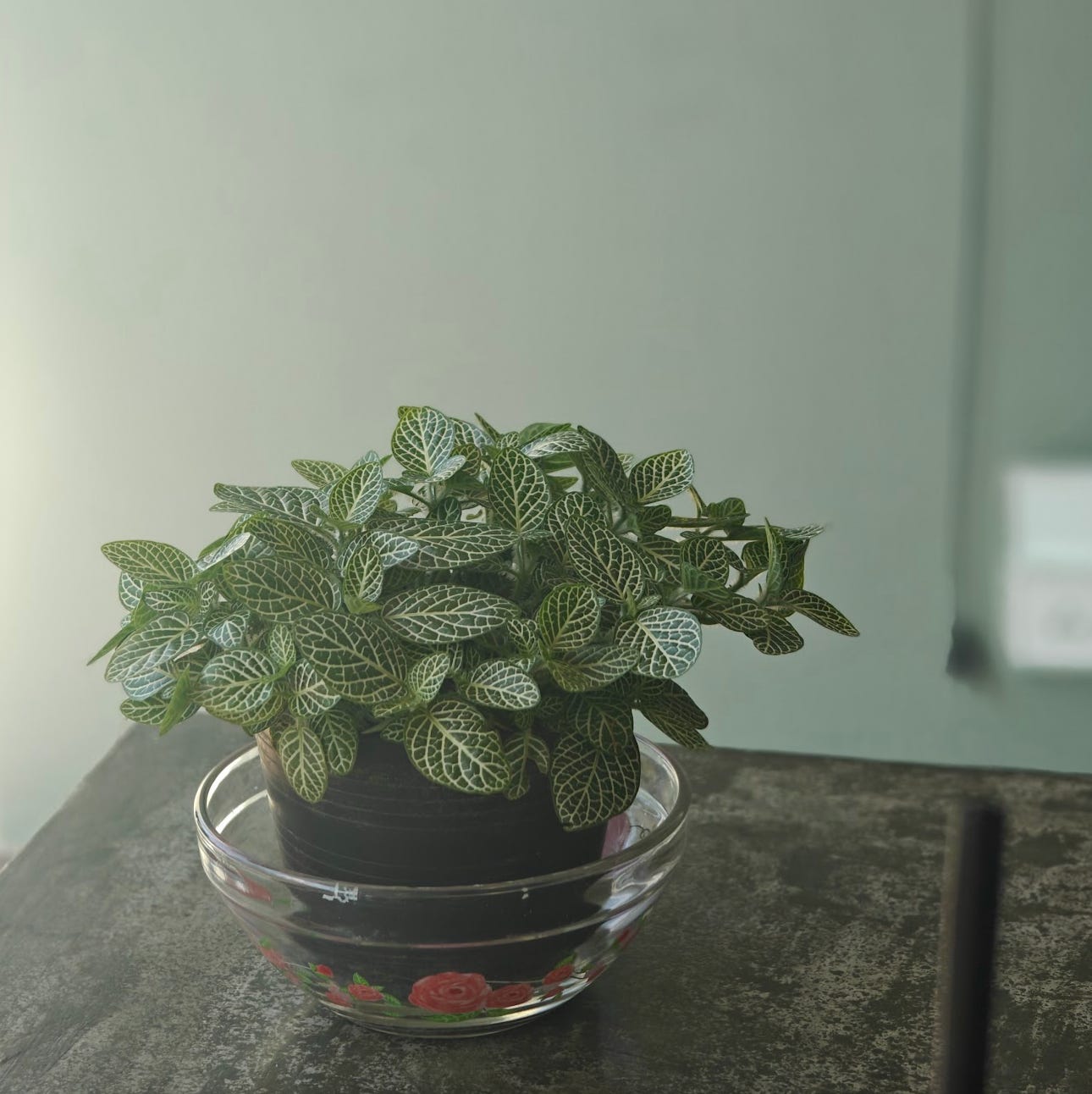
Why Plants? The Core Experimental Premise
Unlike digital interfaces that can be optimized, abstracted, or endlessly modified, a plant presents irreducible physical reality. It has needs that cannot be negotiated. It responds to care - or neglect - in visible, measurable ways. It exists in time: growing, changing, evolving.
This creates a feedback loop that mirrors the steward’s own patterns of attention, consistency, and care capacity. The plant becomes an externalized diagnostic tool. How someone cares for it reveals how they relate to:
1) dependency
2) responsibility
3) continuity
The plant doesn’t judge, but it does respond—offering something rare in contemporary digital life: honest, non-verbal feedback about actual behavior versus stated intentions.
Theoretical Foundations: Why We Bond With the Silent and the Green
The project draws on four bodies of research to explain why this works.
Para-Social Relationship (PSR) Theory was originally developed to explain one-sided bonds with media figures1. Applied here, it explains human-plant relationships through two mechanisms: homophily (bonding with those perceived as similar to ourselves) and anthropomorphism (attributing human traits to non-human entities) - both fundamental processes for extending care across the species boundary.
Physiological evidence confirms the benefits are real. Active plant care - transplanting, pruning, watering: down-regulates the sympathetic nervous system within 10-15 minutes, with diastolic blood pressure dropping by an average of 4-6 mmHg2. EEG studies show that even visual exposure to living plants increases Relative Theta power (deep relaxation) while decreasing Relative High Beta power (stress and anxiety)3.
Attention Restoration Theory (ART), developed by Rachel and Stephen Kaplan4, explains why this matters for knowledge workers specifically. Directed attention - the kind required for deep work, writing, decision-making, is a finite resource that depletes through use. Natural elements restore it by engaging effortless, involuntary attention. Plant care functions as a structured micro-break: moderate novelty, no cognitive demand, genuine restoration5.
Technostress - the pathological inability to adapt to constant digital demands, manifests as compulsive checking, phantom notifications, and baseline anxiety6 Plant care interrupts this cycle through mandatory presence. You cannot water a plant while checking messages. The plant demands co-location and focused attention, creating structured breaks that participants described not as interruptions but as relief.
Three Hypotheses—and What the Evidence Showed
H1: Does the plant become a mirror?
Plants function as mediating objects through which participants project and examine their own relational patterns: a low-risk environment for practicing care.
Yes. Four distinct archetypical patterns emerged:
Projection of relational patterns and self-care. One participant explicitly treated care as reciprocal: “I take care of him how I would like to be taken care of…”
Safe space for experimentation. Another used the plant to practice decision-making with lower stakes than human relationships: “I’m using that opportunity to learn about myself... there’s less risk than doing that with humans... I can make more mistakes.”
Mirroring self-sufficiency/self neglect. One participant’s care style directly mirrored their own self-perception: “They don’t need much care, so I let them be... I don’t need care. Only a bath once a week.”
Resistance to projection. One participant who resisted anthropomorphism entirely, preferring respectful coexistence: “We are roommates... We respect each other’s space.”
If you have plants, take a look at them, which pattern feels relatable? if any? That answer likely tells you something about how you show up in other relationships too.
H2: Does plant care restore rather than add to cognitive load?
Stewardship offers meaningful activity outside the productivity paradigm - restoration without the guilt of “unproductive” rest.
Yes. Participants consistently described plant care as a “natural dopamine boost” that brought “calmness and relaxation”- a transition mechanism from high-stress cognitive work to a relaxed state. Crucially, it integrated naturally into existing routines: morning rituals, hydration, yoga practice. One steward described finding new locations for the plant as “fun” rather than “effort.” Others noted it helped them stay “in flow” even in high-pressure periods.
Plant-care offers task completion without productivity pressure. It is discrete, finishable - a rare quality in lives otherwise defined by endless digital workflows.
H3: Does temporary ownership deepen or diminish care?
Care and connection can persist across transitions through intentional handover - the chain of responsibility outlasts any individual steward.
Counterintuitively, yes - temporality intensified care. One participant put it directly: “Knowing that you cannot take it with you. It only enrich the experience otherwise it just another... object that you... place it in the corner of your house.”
Due the constrains of the residency duration, I couldn’t test the handover process in person. Despite that during interviews they shared about developed genuine attachment despite knowing it was temporary: “I don’t look forward to giving him [the plant] away.” Anxiety emerged around finding the right successor: “I want to pick the person that I want to see in their eyes, that they would take care.” Another described it as both “a bit of a burden” and “an opportunity to connect with people.”
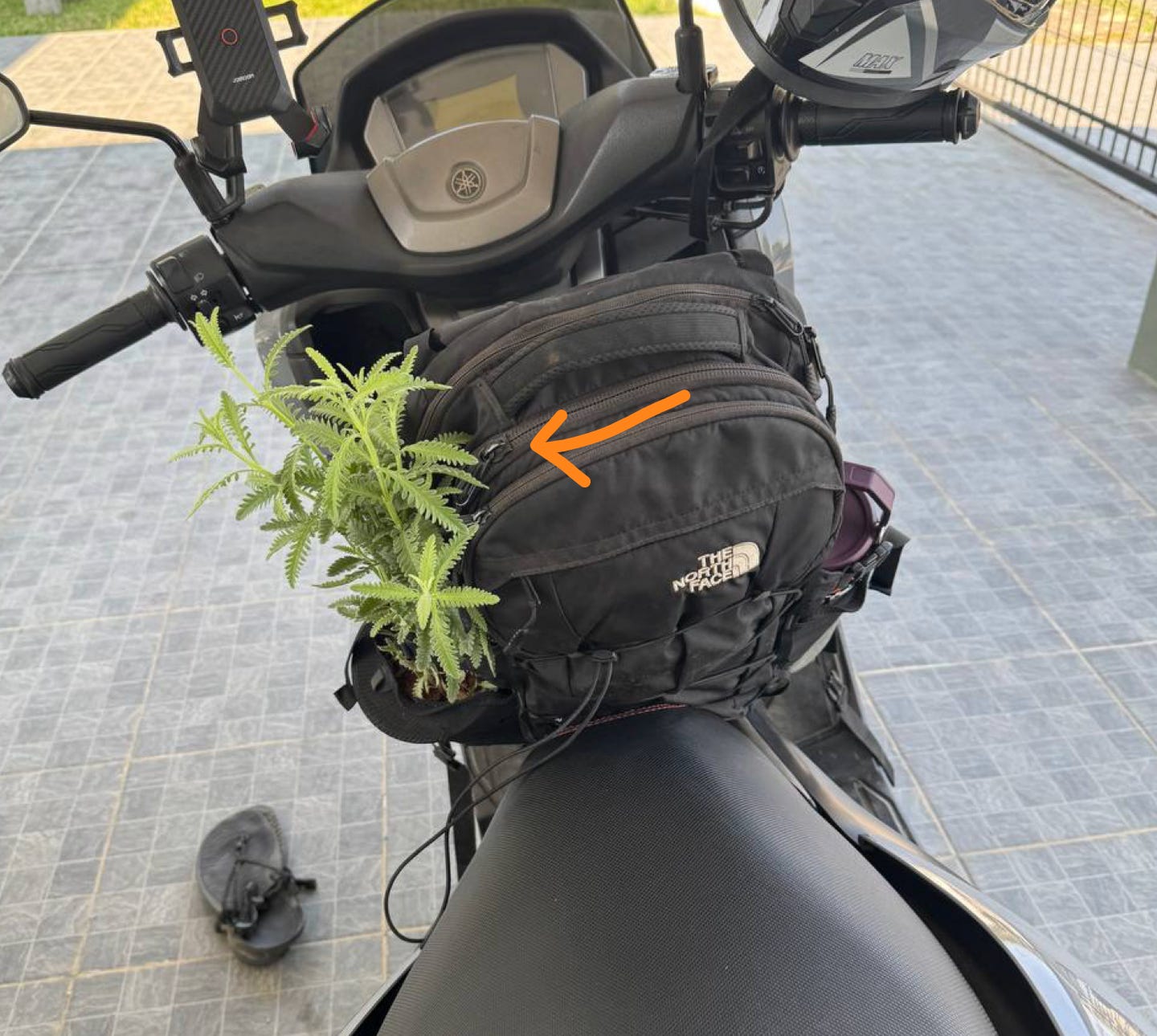
The plants had become social actors with moral weight. Temporary relationship didn’t prevent real bonding - it redirected responsibility from possession toward continuity.
What the Research Raised: Problems Worth Designing For
The residency surfaced several tensions that any scaled version of this model would need to address. These questions motivated the technical infrastructure I’m now developing specifications for.
How do you ensure continuity when people leave? Several stewards felt anxious about abandoning their plant without a worthy successor. The handover was emotionally significant - but also logistically fragile. Without a reliable network, plants risk becoming orphaned.
How do you balance private reflection with shared narrative? Some stewards wanted their care logs to remain personal. Others saw the shared story as the point. Any documentation system has to hold both.
How do you sustain motivation across handovers? Intrinsic motivation—the wellness benefits, the relational practice—was sufficient for most participants during the residency. But over longer time horizons and more transitions, extrinsic reinforcement may matter.
Toward a Technical Protocol: Specifications in Development
These problems point toward a sociotechnical infrastructure for nomadic stewardship.
Digital Plant Passport. A living document traveling with each plant, recording biological data (species, health history), spatial history (locations and photos), stewardship chain (dates and optional reflections), and a care calendar. Implemented via QR code linking to a shared database with mobile-optimized entry. The key principle: value lies in intentional documentation, not automation. The act of logging care is part of the practice itself.
Mindfulness Integration. Optional reflective prompts triggered by care moments:
After watering: “What did you notice today that you haven’t noticed before?”
After checking growth: “What changed, in the plant or in you, since you last really looked?”
During repotting: “What are you trying to make more room for in your life right now?”
One participant’s self-directed version of this surfaced an insight worth sharing: “I realized I always say the plant ‘seems droopy’ on days when I’m actually the one who’s exhausted. The plant was fine. I was the one wilting.”
Privacy Architecture. A two-tier system: public metadata (care log, photos, basic facts) in the shared passport; private reflections in individual accounts, published only by choice. Plant biographies would be curated from voluntary disclosures - more anthology than diary.
Stewardship Credentials. Digital certificates recording each person’s tenure as a steward - not for speculation, but as verifiable proof of care. Documentation that you were somewhere, cared for something, participated in a chain. Potentially serving as reputation in future stewardship networks.
Future Directions
The Stewardship Marketplace. A potential network of cafes, co-working spaces, and community gardens serving as handoff points—where departing stewards drop plants, and arriving nomads can claim and adopt them. Each location maintains a small rotating collection; plants are visible on a shared map with full histories.
Open Research Questions:
Does care quality decrease over sequential transfers, or stabilize at a baseline?
What’s the optimal plant lifespan before biological limitations make further transfer impractical?
How do cultural differences in plant symbolism affect participation?
Do certain species thrive better as nomadic plants than others?
Can the documented care chain itself become a form of narrative art?
Conclusion
The Nomadic Plants project doesn’t solve the tension between mobility and rootedness—it reframes it. The question isn’t how to recreate permanent ownership in a transient life. It’s what becomes possible when we accept transience as the condition for deeper attention.
What I observed: caring for something you know you’ll have to give away doesn’t make the relationship less real. It makes the time more deliberate. You notice more. You invest more. You think carefully about who comes next.
That’s the closing argument. Our nomadic lives don’t need to be defined by what we can’t hold onto. The practice of stewardship—showing up, paying attention, passing forward—turns out to be not a consolation prize for the rootless, but a more honest relationship with time itself.
The plant doesn’t need you forever. It just needs you now.
Footnotes
Horton, D., & Wohl, R. R. (1956). Mass communication and para-social interaction: Observations on intimacy at a distance. Psychiatry, 19(3), 215-229.
Park, S. A., Song, C., Oh, Y. A., Miyazaki, Y., & Son, K. C. (2017). Comparison of physiological and psychological relaxation using measurements of heart rate variability, oxyhemoglobin, and subjective indexes after completing tasks with and without foliage plants. International Journal of Environmental Research and Public Health, 14(9), 1087.
Igarashi, M., Yamamoto, T., Lee, J., & Song, C. (2014). Effects of stimulation by foliage plant display images on prefrontal cortex activity: A comparison with stimulation using actual foliage plants. Journal of Neuroimaging, 24(2), 127-130.
Kaplan, R., & Kaplan, S. (1989). The experience of nature: A psychological perspective. Cambridge University Press.
Kaplan, S. (1995). The restorative benefits of nature: Toward an integrative framework. Journal of Environmental Psychology, 15(3), 169-182.
Tarafdar, M., Tu, Q., Ragu-Nathan, B. S., & Ragu-Nathan, T. S. (2007). The impact of technostress on role stress and productivity. Journal of Management Information Systems, 24(1), 301-328.